The Blue Room
The Blue Room contains hundreds of blue transferprinted pieces made at Spode between c.1790-1847 and is almost certainly the largest and most important collection of Blue and White printed ceramics on public display in the world. Tours of the Blue Room now available for 2025
Learn moreWe offer private tours of our famous ‘Blue Room’ most days we are open, but you do need to be booked in advance to avoid disappointment.
Each tour lasts approximately 45-60 minutes and our talented guides will give you a fascinating insight into the wonderful blue and white printed earthenware which made the Spode name famous across the globe. There is a small charge per visitor which supports our charity and helps to keep our museum free to enter for all.
For further information or to book a tour please contact us by email on: contact@spodemuseumtrust.org
Josiah Spode developed the technique for transfer printing on earthenware in the 1780s – his process has been copied throughout the Potteries and abroad for over two centuries. His earliest patterns were Willow Pattern variants, but by 1830 he had produced hundreds of new designs – often with Oriental subjects, but also with new European landscapes, including his most popular design of all, “Spode’s Italian”.

The room is located in one of the period buildings in Josiah Spode’s original factory and contains the most important collection of early Spode transfer printed ceramics on public display in the world, with hundreds of pieces in a wide variety of patterns and shapes. Many pieces are rare and unusual – items made for apothecaries, footbaths, bourdaloues, suckling pots, and pap boats. Also, armorial pieces made for army regiments on duty in India and across the Empire, made for an array of uses ranging from dining to spittoons and chamber pots, all made in the late 18th and early 19th centuries. It also contains a display of 18th century Chinese porcelain originals, which provided the inspiration for many of Spode’s designs.

In Spode’s time, printing on earthenware was revolutionary. Intricate patterns could be printed in a fraction of the time it would have taken to paint them by hand and much larger quantities of highly decorated ware could be produced far more cheaply than ever before. To achieve this, new engraving and transfer printing skills had to be developed and in these, Spode’s workers excelled; designs copied from topographical prints published in books of the period were not just reproduced but often improved. Spode’s productions are considered the finest made by any factory.

The Blue Room display is just part of the much larger Spode Museum collection. It was first displayed at the Spode Factory in the 1930s and subsequently augmented by donations and acquisitions of rare pieces from private collections. When it was first displayed, it was set out openly on period furniture creating a more informal setting for visitors and today much of the collection is shown in the same way.
-
 A confection of various blue printed transferware
-
 Net Pattern Supper Set
-
 Indian Sporting Pattern
-
 Botanical Patterns - British Flowers
-
 Spode Aesop's Fables pattern "The Horse and the Loaded Ass"
-
 Italian Pattern
-
 Spode's Caramanian Pattern
-
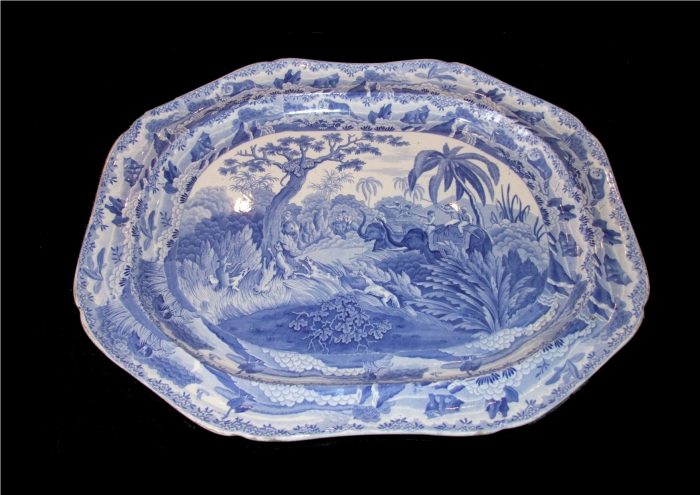 Spode Indian Sporting pattern "Shooting a leopard in a tree"
-
 Spode's Greek Pattern


