The Daniel Ceramic Circle (DCC) staged an exhibition of Daniel porcelain demonstrating Henry Daniel’s contribution to the Spode story and marking the 250th Anniversary of Spode. This was the first time a collection of Daniel wares was seen in public. the Exhibition was staged in the Daniel Room which houses examples of Spode and Copeland porcelain decorated with a botanical theme.
The DCC continued the theme of botanical and flower painting, highlighting the gilding, with emphasis on the early shapes of Daniel wares after Henry set up his own business.
Henry Daniel came to the Spode factory some time before 1805 and worked with Josiah Spode II until 1822. He was responsible for much of the decoration of Spode’s wares, including all of the beautiful hand painting on the newly introduced bone china pieces.
The arrangement between Daniel and Spode II was unique at the time – it was in effect an outsource deal. Spode sold Henry Daniel his wares in the white, Henry Daniel decorated them and sold them back to Spode II. The workshops and bottleovens that Henry Daniel built were all located right here inside the Spode factory perimeter.
It is an irony that many thousands of beautiful pieces, marked ‘Spode’, were actually decorated by Henry Daniel’s team of artists.
In August 1822 Henry started his new business venture. In 1826 his son Richard became a partner in the enterprise that continued until 1846. Following on from his successful arrangement with Spode, Henry Daniel must have been confident in his ability to make a success of another manufactory on his own account, not only enamelling porcelain products but making them as well. It isn’t known how many of his former workers elected to continue in his employ. What is known is that throughout the 24 years that the factory existed, the Daniels maintained a superlative workforce of armorial artists. William IV, when Duke of Clarence, ordered a magnificent dessert service bearing the Garter motto. The service may be viewed at Windsor Castle.
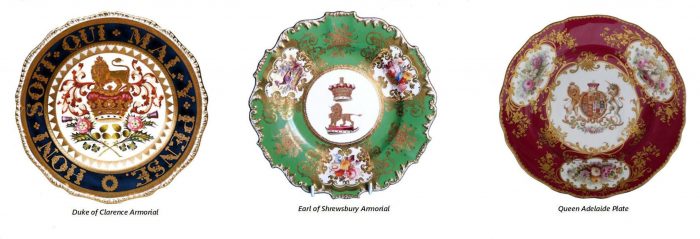 The Earl of Shrewsbury is credited with being Daniel’s greatest patron. He commissioned a very large order, which was produced for him in early 1827. The Earl didn’t get much opportunity to enjoy his purchases as he died in the April of that year. However, his successor, John Talbot the 16th Earl of Shrewsbury, must have been impressed. He continued to place orders with the manufactory that included a wedding gift for his daughter, Mary Talbot, on her marriage to Prince Filippo Andrea Doria Pamphilj Landi.
Flowers were a popular subject with patrons and Daniel’s arrangements were beautifully executed whether in loose sprays, more formally in baskets or even framing landscapes. Following the trend of the day where the wealthy indulged in folios of lithographic botanical prints, so too are they depicted on porcelain. Richard Daniel wrote to his father imploring him to engage “good flower painters” and to “take no more common painters and gilders, we must have the very best only.” William Pollard is renowned for his painting of hedgerow plants, these included primroses, speedwell, heathers, gorse and dog roses. He was employed by Henry Daniel “for a brief period between 1822 and 1826” as a decorator. Examples of his work may be found on both tablewares and ornamental wares. Birds too were portrayed sometimes just as an outline shape infilled with gilt or very simply in just two colours. These contrast dramatically with the more flamboyantly painted exotic birds and even more so when compared with ornithological examples. Also captured in enamel are fruit, shells and insects.
All parts of the finished goods had to be exemplary and a workforce skilled in various roles was needed. A few of these include ground laying, gilding, colour making besides enamelling and the all-important firing. Daniel’s gilders were amongst the best to be had, the names of a few of them are known such as Heber Marsh though we do not know which pieces he gilded. Daniel’s work often featured sumptuously but delicately painted gilding. Henry Daniel is credited with being the first to introduce raised gilding.
Richard Daniel lived in London initially, promoting the wares of the manufactory. It is clear from a letter he wrote to his father that the goods outshone some of their competitors, writing, “Poor Ridgway says we cut up his trade and John Rose sends out the goods so bad everybody complains. Mr Yates is nothing in this market.” Orders were flowing in; Richard requested his father to “have made sixty or eighty dozen larger gadroon Desserts.” Daniel and Palmer “would have ordered twelve Table Services if I had them. They will keep their stock low until ours comes out”, they had however purchased “eight of the very best Desserts … besides lower priced ones the whole order will come to £400.” A Mr Phillips bought “seven rich Dessert Sets and eight lower priced ones besides a large quantity of Gadroon Tea and B’fast Ware.”


